
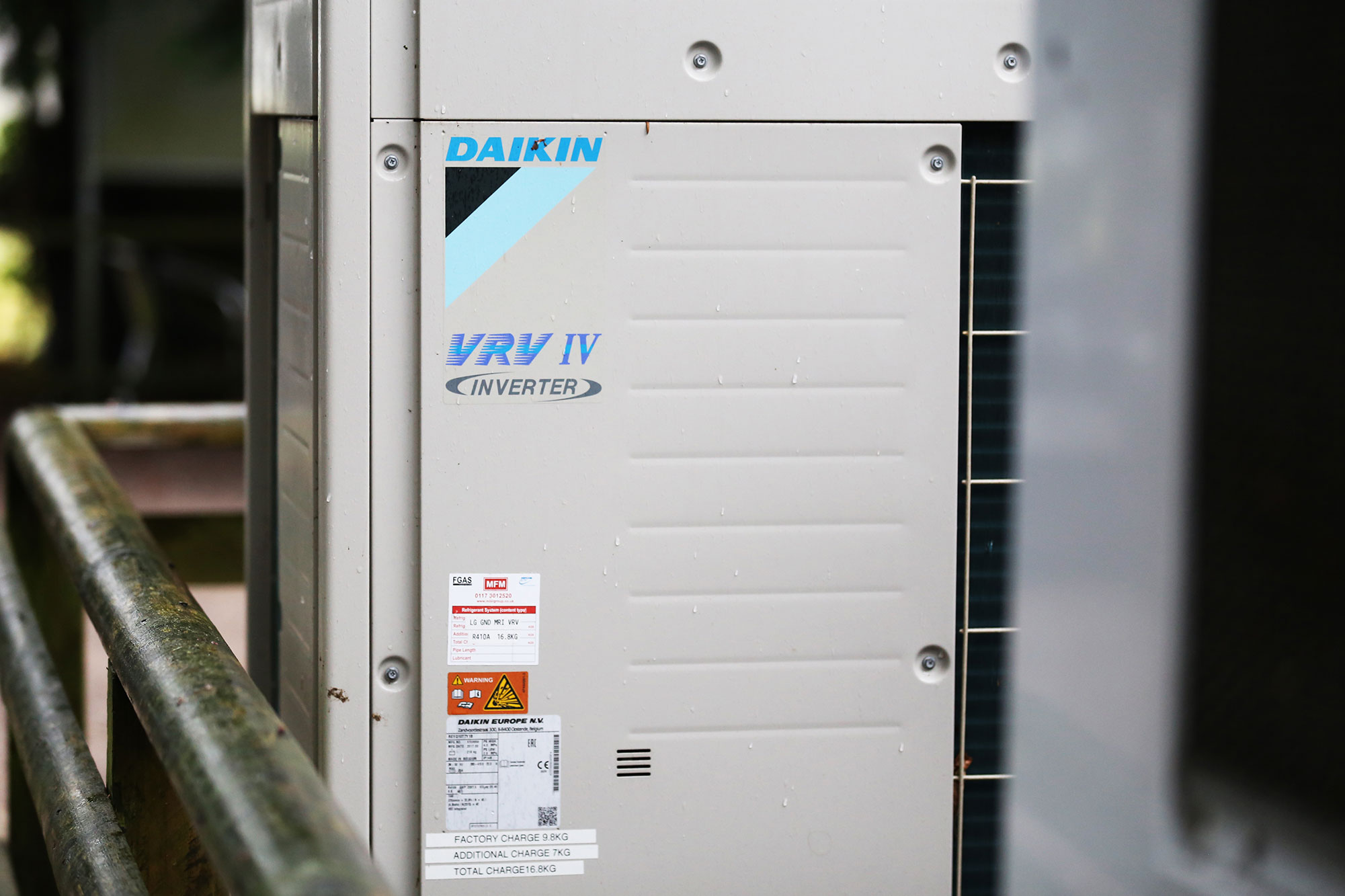
A system of air conditioning, now known generically as Variable Refrigerant Flow (VRF), was invented by Daikin in 1982 who named and trademarked their invention “the Variable Refrigerant Volume” System (VRV).
The Basics of VRF Systems
VRF systems are air-cooled and refrigerant-based, using outdoor condenser units and indoor fan coil units in the same way as more traditional air conditioning systems. However, instead of one large unit pumping air to the whole space, a VRF HVAC system incorporates several smaller air handlers which can be controlled individually and piped back to one system. The term variable refrigerant flow comes from the fact that the system provides the ability to control the amount of refrigerant which flows to each of these small air handlers.
A VRF system incorporates multiple units which can be located throughout a building. This means that by manually or automatically altering of the volume of refrigerant being sent to any particular indoor unit, it is possible to exactly meet the cooling or heating needs of each different zone in a building. This provides the ability to maximize cooling or heating power, while additionally avoiding spending more on heating or cooling unused areas of the building.
The Types of VRF Systems & How They Work
There are essentially two common types of VRF, one only provides cooling or heating at any one time, which means that all zones will either be cooled or heated, but not simultaneously. The other system allows both cooling and heating to occur simultaneously.
Usually, these two systems are referred to as “2 pipe” and “3 pipe”, with the 2 pipe providing either zoned cooling or heating and the 3 pipe system providing simultaneous zoned heating and cooling. The 3 pipe system is popular, as throughout the year many buildings require cooling in some areas while others need heating. With the heat generation of IT equipment, contrasting needs may occur even between adjacent rooms. The 3 pipe system addresses these needs by distributing surplus heat from cooling operations (and vice versa) to the areas where it is required. This efficiency results in energy savings which can be up to a third over conventional systems.
VRF systems are usually installed with an air conditioner inverter which adds a DC inverter to the compressor to support variable motor speed. This allows variable refrigerant flow rather than simply performing an on/off operation. Having the capacity to operate at varying speeds means that VRF units work only at the required rate, thus creating substantial energy savings.
As a user turns one of the indoor units “ON” through its local remote, the outdoor unit is communicated to, and begins working. It will examine the outdoor temperature, the indoor requirements (operation mode, set point temperature), and will proceed to operate the compressor at the precise level, required to meet the indoor requirements.
Upon another indoor unit being turned on, the outdoor unit will recalculate the requirements from all the indoor units, and increase the compressor’s output, to meet the new required level of demand.
This process occurs with any change that is generated in the HVAC system. The system is fully automatic and regulates its power consumption based on the demand that arrives from the indoor units and the outside prevailing temperatures. The user has the ability to influence the indoor comfort conditions, by modifying: Operation mode the operation state (Cool/Heat/Fan/Dry/Auto), the setpoint temperature and fan speed (high/medium/low/auto).
Additionally, heat exchangers situated in distribution boxes transfer some of the reject heat to the refrigerant that is being directed to the zone requiring heating, which has the potential to add significant energy savings. VRF Heat recovery units essentially take heat from one space that wants to be cooled and gives it to another space that wants heating.
Mitsubishi has developed technology that enables the facilities of the 3 pipe system to be achieved through a 2 pipe system using a Branch Controller (BC) to the individual indoor evaporator zones. As with the 3 pipe system heat that is extracted from zones requiring cooling can be put to use in the zones requiring heating, because the heating unit is functioning as a condenser and providing sub-cooled liquid back into the line that is being used for cooling. The Multi Heat Recovery Systems centres around the BC Controller which contains a liquid/gas separator. This allows the outdoor unit to deliver a mixture of hot gas for heating and liquid for cooling, all through the same pipe as opposed to the 3 pipe systems which allocate a pipe to each phase. When the mixture arrives at the BC Controller, it is separated. The correct phase is then delivered to each indoor unit based on the individual requirement of either heating or cooling.
The Benefits of VRF
On top of the benefits of simultaneous zonal cooling and heating control, the VRF air conditioning systems also benefit from being flexible and modular in their design. A number of outdoor units can be linked together to increase the capacity of the overall system and, consequently, increase the possibility of heat recovery. The indoor units come in many types and sizes which makes them suitable for most applications. In the situation where there is limited space, systems can be engineered to minimise or totally remove the need for air distribution ductwork, which makes them cost effective to implement and easier to install.
The sophisticated controls allow the system to be optimised and gives the user complete control over their local environment, with no adverse impact on the other areas served by the same system. Furthermore, these controls can easily be integrated into the buildings BMS control system as required.
As indoor units run at decibel levels between 19 and 34, and the outdoor units operate quieter than a typical conversation, the VRF system also has the advantage of being quiet.
Getting Help
If you have enquiries about your existing VRF HVAC system or are considering installing one, it is very important that you deal with a company providing properly qualified installation and maintenance engineers.
For more help, simply get in touch with our expert team here at MFM Group.