
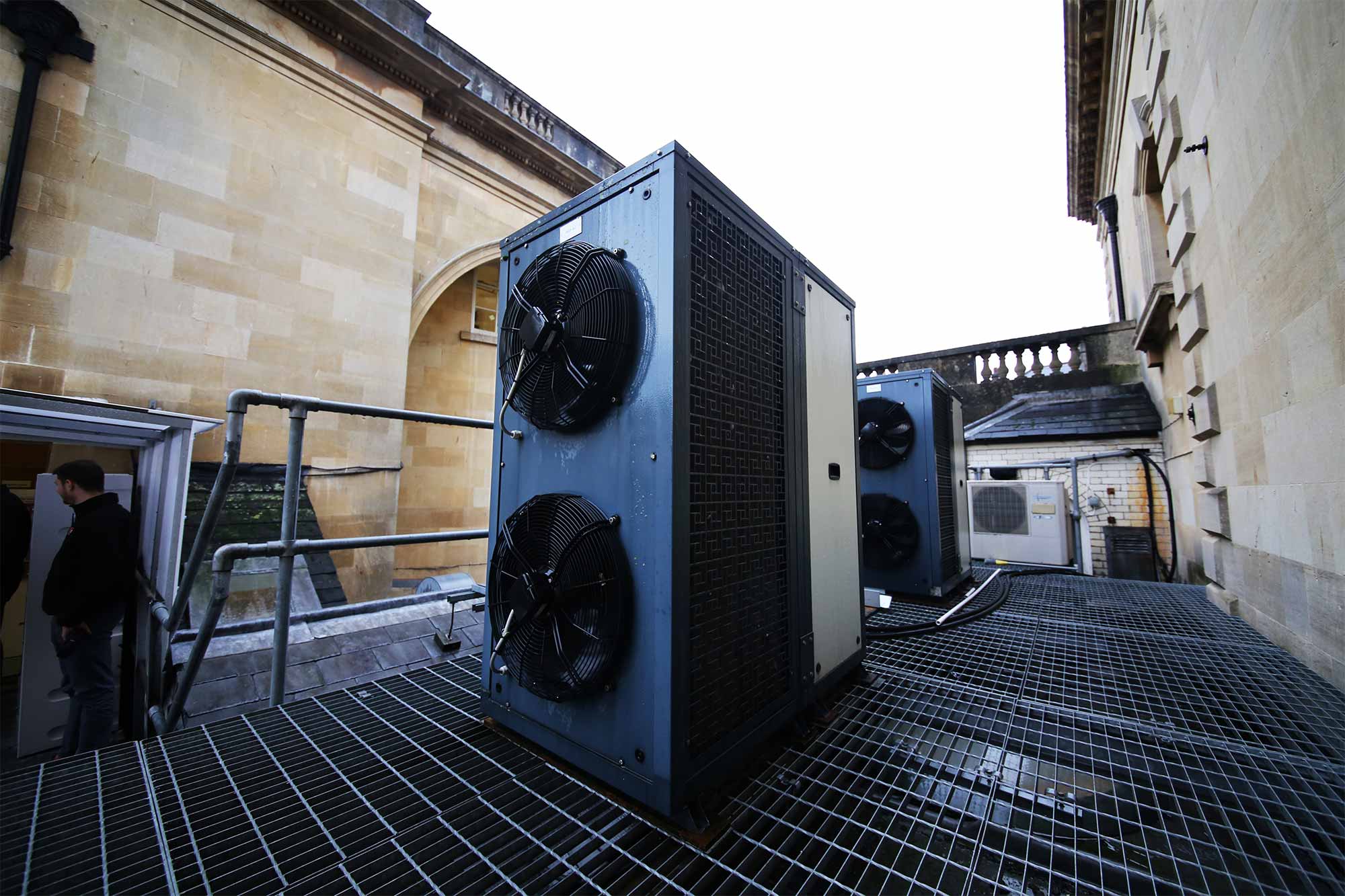
Air conditioning (AC) systems utilise the processes of evaporation and condensation to create a cycle in which a refrigerant moving through the system continually absorbs heat from the interior of a building and expels it into the atmosphere outside the building.
The Refrigerant Cycle
The key components in this process are a compressor, a condenser, an expansion valve and an evaporator.
The refrigerant is transformed four times in the process. It leaves the condenser as a high-pressure liquid and is then reduced in pressure by the expansion valve into a low-pressure liquid. It moves on to the evaporator where this low-pressure refrigerant liquid attracts the warm air from the building and in so doing becomes altered into a low-pressure gas. The compressor then pressurises this gas so that it leaves it as a high-pressure refrigerant gas. This high-pressure gas then enters the condenser where heat is extracted and the refrigerant cools into a liquid ready to begin the cycle again.
This cycle, therefore, is a process of transferring heat in which the refrigerant repeatedly gets converted into a gaseous state when it absorbs heat and into a liquid state when it gives up its heat to the atmosphere.
The Compressor
A compressor has two essential components, namely a power source and its compressing mechanism (piston, vane, etc).
The compressor works by allowing air to enter the piston or vane, which is compressed by increasing its pressure while decreasing its volume. Once the pressure reaches a maximum set by the manufacturer, a switch mechanism prevents any more air intake into the compressor. The compressed air is then used, and the pressure levels decrease. As soon as the pressure reaches a minimum level, also set by the manufacturer, the switch allows more air to enter the compressor.
The Condenser
The “condenser unit” contains many components, including the condenser tubes and fins, the compressor, a fan and copper tubing, together with valves and switches.
When the refrigerant gas leaves the compressor, it flows into the condenser coils. It is here where the refrigerant releases much of the heat that it absorbed inside the building. The fan on top of the outdoor unit blows air over the condenser coils to allows the refrigerant inside them to relinquish its heat. The many coils inside the condenser increase the time the refrigerant is in the path of blowing air, giving it plenty of time to release the heat carried out of the building.
From the condenser the liquid refrigerant flows back through copper tubing into the building and into the expansion valve, usually located in the indoor unit near the evaporator coil.
The Evaporator & Expansion Valve
An air conditioner’s evaporator coil is the part of the system where the refrigerant absorbs heat. The evaporator coil is situated inside or near the air handler containing a blower fan. Evaporator coils are either copper, steel, or aluminium as these metals conduct heat easily. Most residential AC evaporators consist of tubes bent into U-shapes which are set into panels.
These panels are usually positioned in the form of an “A” and are lined with fins, which direct the passing air requiring cooling closer to the coils. This maximizes the effect of the refrigerant. Before it enters the evaporator coil, the refrigerant is passed through an expansion valve. This valve reduces the pressure from the liquid refrigerant, and by so doing, quickly cools it. The liquid refrigerant leaving the expansion valve is then sufficiently cold, to allows for the absorption of heat from the air. The expansion valve is also responsible for controlling exactly how much refrigerant flows to the evaporator.
A blower fan draws warm air from a room over the evaporator coil and the refrigerant absorbs heat from the passing air and in so doing warms up and, with its low boiling point, evaporates.
As water vapour in the warm air hits the cold evaporator coils, the water vapour condenses into a liquid form and drips into a condensate pan. This process drains the water away outdoors and reduces the humidity in the building.
The Refrigerant
For a chemical fluid to be used as the refrigerant it should possess particular physical, chemical and thermodynamic properties which will make it both safe and economical to be used as the refrigerant.
One of the key aspects of a refrigerant is its low boiling point. This very low boiling point allows the refrigerant to boil at room temperature which facilitates the extraction of warm air from the room when that air is blown across the very hot refrigerant.
As a result of the 1987 Montreal Protocol on Substances that Deplete the Ozone Layer, the refrigerants known as hydrochlorofluorocarbons (HCFCs) are being phased out and replaced by hydrofluorocarbons (HFCs). The problem with HCFCs is that they contain chlorine which is much more destructive to ozone than HFCs.
Most manufacturers identify which refrigerant an air conditioning unit uses with a sticker or plate situated either on the compressor or evaporator. This sticker may indicate “R-410A” or “R22”, for example. It’s important to know which type of refrigerant the AC uses before replacing it, since they are not interchangeable. HFCs need to operate at higher pressures than ACs that use HCFCs, which means they can be smaller.
As a result of these differences, it is possible to damage or destroy an AC unit if an incompatible refrigerant is used with it. It is important to seek the advice of an experienced technician before replacing a refrigerant or before converting an older HCFC-based AC to HFC refrigerants. Refrigerants can also be dangerous if mishandled and can usually only be bought by licensed technicians. Older HCFC refrigerants will need to be safely disposed of in order to limit the potential environmental damage caused once it has been removed from the AC.
R-410A is a type of HFC refrigerant that is commonly found in newer AC units. It is a mixture of two other HFC refrigerants, R-125 and R-32, and provides greater cooling properties than the older HCFC refrigerants under high pressures. Furthermore, R-410A also does not harm the ozone layer.
Learn More with MFM Group
Aside from the issues surrounding refrigerants, it is important to regularly maintain an AC system. Dirty evaporator coils can create a number of problems, such as impairing heat absorption and cooling capacity, higher pressures and temperatures, frost and ice build-up, and higher energy usage.
Good airflow is essential for both evaporator and condenser coils, and dust or debris interfere with their ability to transfer heat. For condenser units, the biggest problem is a build-up of debris on the fins from such things as grass clippings, fallen leaves, twigs, and even pet hair, all of which can make it harder for the condenser to release heat. This reduces the energy efficiency of the AC and puts a strain on the condenser and other components.
For quality advice on maintaining and servicing your air conditioning system, simply contact our team here at MFM Group.